Skip to content
News
Montana Ambassadors Host Montana State’s President Tessman and University of Montana’s President Shinn as they speak publicly together for the first time
Montana Ambassadors’ Big Sky event convenes rival presidents for rare side-by-side chat

Rival presidents Brock Tessman and Jeremiah Shinn bridged the Great Divide last week during their first joint-speaking appearance.
The new faces of Montana’s flagship universities sat for a panel discussion moderated by the Chronicle at the Montana Ambassadors’ annual summit at The Wilson in Big Sky on Wednesday, Sept. 16. The Montana Ambassadors is a statewide cohort of business leaders and entrepreneurs.
School administrators say presidential meetings of this sort have happened rarely, if ever, in the past 10 to 15 years — aside from standard gatherings like the Board of Regents that governs Montana public universities.
Tessman, who took the helm at Montana State University in July 2025, emphasized his budding friendship and working relationship with Shinn, who began at the University of Montana on July 1. Shinn recounted Tessman and his wife, Kristin, driving to Missoula on a weeknight this summer to welcome the new president and his wife over dinner. Nonetheless, the Sept. 16 meeting was their first public-facing chat.
Tessman framed the friendly talk as a model of civility, engagement and dialogue that underscores the ongoing partnerships between MSU and UM.
“I like the rivalry, but the fact that you can hold that in one hand and still really be as engaged, as trustful and as collaborative as can be, that’s a big deal,” Tessman told the audience of a few dozen business and industry leaders.
The presidents discussed their impressions of MSU and UM in their initial months on each respective job, and took questions regarding AI philosophies, industry partnerships for hands-on experience and career readiness, traits of the modern college student and their visions for collaboration between the universities.
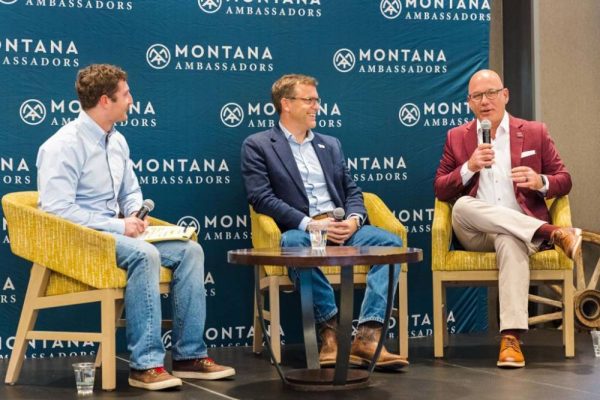
UM President Jeremiah Shinn, right, joined MSU President Brock Tessman, middle, and Chronicle Managing Editor Jack Reaney on stage on Sept. 16.
Jason O’Neil/Montana Ambassadors
The following summary includes excerpts from a 35-minute discussion. The Chronicle asked the following questions:
Tell us about something that you’ve found in your college town — Bozeman or Missoula — that you really enjoy.
When Tessman took the job and left Northern Michigan University in 2025, he knew it would be difficult to move his family back out West. Thankfully, he said, they’ve settled right in over the past year and change.
“One of the most pleasant surprises for me is not necessarily about the job, it’s about the fact that, coming back to Montana and settling in the Bozeman community has been just easy as can be,” Tessman said.
Shinn spent the past decade-and-a-half in multiple roles at Boise State University, with an intermittent period as VP of student affairs at Louisiana State University from 2019 to 2023, before returning to Boise State to serve as interim president. New to Montana, he praised the Missoula community for making him feel at home.
“I’ve been joking that if we had felt half as welcome as we have been, I would still be over the moon,” Shinn said. “… Listen, I’m from the South and they talk about Southern hospitality. I’ll tell you, Southern hospitality is about an inch thick, and the Montana hospitality is real. It’s real.”
What’s been unexpectedly great, and what’s been surprisingly challenging in your new roles?
Shinn anticipated the usual: fear of change, and stubbornness in the face of new leadership.
“I’ve not experienced even a little of that,” Shinn said. “… [People] have said, ‘We want to be as good of a university as we can possibly be. Let’s go — what do you need from us?’”
Shinn believes UM faces the same challenge as many other universities: It has been optimized for faculty and staff more than it has been for students.
“The university that we were in 2019 cannot be the one that we are in 2035. The world is changing too fast for us to stand still, and we have to optimize differently because our students demand it, our employers demand it, the world demands it,” Shinn said.
Tessman agreed, and said for all the great things happening at MSU, the challenge is to avoid complacency and “use the momentum” to continue reinventing.
Last fall, Tessman was pleasantly surprised by the vibrancy of MSU’s campus.
“I, of course, knew about the success of MSU over the years,” Tessman recalled. “You don’t take a job as president without understanding the trajectory that the university is on. But I landed and thought, holy smokes, we’re at another level here in terms of just the positive intensity in the sense of activity and busyness on campus.”
Beyond the infamous Cat-Griz rivalry, where do you see existing collaboration between our state’s flagship universities, and where would you like to see some more?
Tessman highlighted the SMART FireS wildfire research program — short for Sensors, Machine Learning and Artificial Intelligence in Real-Time Fire Science — where researchers from both UM and MSU study the health impacts of wildfire smoke, effectiveness of prescribed burns and other factors at play each wildfire season.
“That’s your two flagships working together in order to solve real problems that face our whole state, regardless of whether you raise your hand as Cat or raise your hand as Griz,” Tessman said, after the Chronicle polled the room by show of hands.
Montana and Montana State fans watch the 124th Brawl of the Wild in November 2025 at Washington-Grizzly Stadium in Missoula.
Shinn said the universities are collaborating more than people think. When Montana has a problem, he believes the universities will put the Bobcats and Grizzlies aside and leverage their unique resources together to put the people and place of Montana first.
“That Saturday in November, that’s one thing, but the rest of the year, we’re really in it for each other, and I think Montana benefits,” Shinn said.
How do you hope graduates will approach AI in their studies, and after they graduate as they enter fast-changing industries?
Shinn said graduates must know how to work with — and without — artificial intelligence.
“AI can answer a question. It can analyze a dataset,” Shinn said. “It can’t tell us what knowledge to pursue. It can’t tell us what’s right. Those are human questions that require human answers.”
Tessman said this fall, people on campus are scared and confused. Not for lack of perspective or bravery, but because AI is accelerating the pace of productivity beyond human comprehension.
He believes comforting solutions will come not from the profit-motivated private sector, not from regulatory government, but from the public-service-focused research institutions in between.
“I think [we’re] aggressively engaging on artificial intelligence. Not because we feel like it has all the answers or that we want to be naive about it, but because, if not us, who,” Tessman said. “And if not now, when?”
What are you learning about this generation of students that is changing the way you think about education, and the way you prepare students for their careers?
Tessman said MSU students are “back,” if their social development was ever challenged by the ripples of Covid, and today they demand excellence.
Students want answers surrounding AI, sustainability and MSU’s technological research involving the national defense industry. Tessman joked that it’s “so inconvenient” yet “the best thing ever” that students are fully present and asking the toughest questions, challenging administrators and making MSU and the state of Montana a better place.
“No one’s there to show up at a Bobcat football game, just coast through their degree and then get out of MSU,” Tessman said. “They’re like, ‘Let’s go.’”
Shinn agreed that students are “informed consumers,” asking tough questions about the value of a college degree.
“We have to be able to tell a different story about the value of higher education because they’re coming from a place and from a society that that has questions about the value of higher education,” Shinn said. “And they’re fair questions, and so our students are asking those questions loudly.”
What do industry partnerships look like on your campus today, and how do these partnerships impact curriculum? And how has that changed in recent years?
Shinn reiterated that students today, more than ever, demand to know how their education will be relevant and competitive as they seek to join the workforce.
“Success today depends on us to work with our industry partners to also co-create what the curriculum looks like,” Shinn said. “We want to be sure that there is no distance between how we’re preparing students and what is needed in business and industry.”
Tessman described the Blue and Gold Industry Roundtable, a new strategic partnership and “very deep and substantial and aggressive move” to connect MSU with key companies.
MSU sees four priorities to build these connections: Getting students career exposure earlier in their college experience; re-aligning curriculum with changes happening in industries; making direct and intentional contacts between businesses and researchers; and taking action on MSU’s responsibility to help move the state forward.
Both presidents described how curriculum is evolving to meet industry needs, versus the past expectation of universities asking industries to hire and train their students.
What is one particular course that’s being taught at your university that you’re really excited about, and you feel captures your personal view of how higher ed should look?
Tessman is proud of a course in the Dan Scott Ranch Management Program where agriculture meets technology. Students learn not only how to work the land, but also how to manage the business and keep the ranch thriving. This covers essentials like accounting, HR and marketing.
“So that students at MSU who want to go back and make sure that their family ranch or farm, and all that kind of intergenerational work that’s gone into building it: it stays in the family,” Tessman said.
Shinn highlighted a class called “Curiosity is a Superpower” that focuses on creativity, problem solving and understanding opposing viewpoints.
“Again, going back to AI: AI can give a heck of an answer. That means that it’s more important than ever that we’re training people who understand how to ask good questions,” Shinn said.
Tessman responded: “That sounds awesome.”
How do you view your university’s role in your surrounding city? So that’s Missoula, Bozeman, Gallatin Valley, et cetera.
Shinn said that of course, UM contributes to Missoula’s economic development, while employing its citizens and educating its population.
“The thing that I think is most underappreciated about universities is the role that we play as a community anchor,” Shinn said. This extends well beyond Griz football, he noted, and into other non-academic attractions. “I’m really proud of the convening role, the organizing role, the bringing people together role that both of our organizations play.”
Tessman is proud that MSU gives opportunities for students from nearby towns to join others from faraway rural communities to fulfil their dreams.
“I hope we show the community anything’s possible,” he said.
Many companies over the years have chosen to locate their headquarters in Bozeman, Tessman added, because they believed in the talent and innovation coming from MSU’s campus.
“I love the fact that we’re helping on the economic development side of things as well,” Tessman said.
The final question referenced a 2026 April Fools’ story from MSU’s student newspaper in which Brock Tessman was “brutally framemogged by a UM frat leader” — a parody of a viral meme online.
How do college presidents like you keep up with the social media and pop culture memes and trends to make sure students don’t view you as an “unc” — lighthearted Gen Z slang for being old, out of touch or out of style — on campus?
Tessman, a father to a nine- and 11-year old, said his kids “make me feel so old and out of touch every single day.”
He believes it’s important to be somewhat aware of trends, but he’s also made the decision to generally stay away from social media.
“I don’t think our students are looking for a friend,” Tessman said. “… I’m good with ‘unc’ status. I think that they may be okay with ‘unc’ status for their president. If I tried, I would fail to keep up — so I let the students just be the students, and I just roll with it.”
Shinn agrees that students value authenticity. He told the story of losing his hair: When his grandmother suggested a comb-over, he realized it was better to embrace baldness.
“I think a comb over is one of those things that just calls more attention to the thing that you’re trying to cover up,” Shinn said. “… Sometimes the most relatable thing you can do is just be authentic, roll how you roll.”
Any other thoughts you want to add?
Shinn thanked the Montana Ambassadors for putting the event together, and emphasized his desire to stay aligned with groups that bring committed Montanans together.
“This is a wonderful place. We have a great business environment. We have hardworking people. We have creativity. We have natural beauty. We have natural resources. We have everything that we need to be successful. And I’m certainly grateful to be in the conversation about how to leverage our great educational institutions to make the state even better than it is,” Shinn said.
Tessman added that MSU is committed to supporting economic and business development across the state, and asked the attendees for their trust and faith.
“I believe there’s no better bet that you all can make, or the State of Montana can make, in its future than in public education,” Tessman said.