Skip to content
News
Randy Gray: American Prairie — here are the facts on the ground
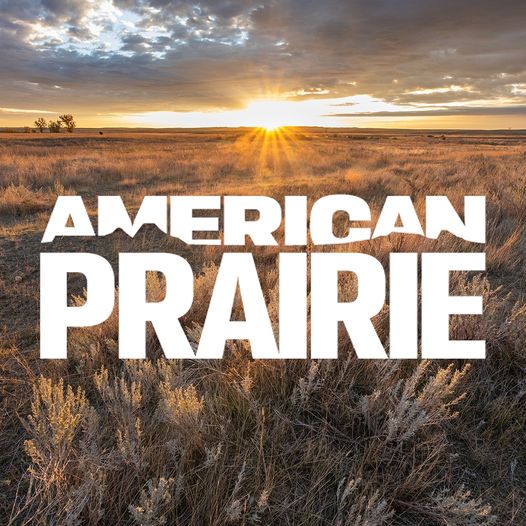
In September, our governor and members of the federal delegation sent a letter to U.S. Department of the Interior Secretary Doug Burgum in opposing American Prairie grazing their “non- production” bison on BLM land in north-central Montana, claiming AP will “re-shape the landscape of our entire state.”
Unfortunately, they badly misunderstand facts on the ground, and the result has been a decision by the BLM to revoke American Prairie’s grazing permits for bison that sets a very troubling precedent for the management of our public lands.
Some landowners have grazing preferences on BLM land for pack animals, like horses and mules, which we don’t eat in this country. Will the BLM revoke all of these because they aren’t “production” livestock? Will a rancher be told they must now raise Herefords, not Angus?
This decision is one of capricious overreach, violating equal protection and establishing a dangerous and destabilizing precedent. BLM lands are owned by ALL Americans, not just adjacent cattle ranchers.
In addition to violating decades of precedent with an arbitrary rule-change, this decision ignores the actual impact of American Prairie’s work.
Of the approximately 600,000 acres AP owns or has grazing rights on, it currently stocks about 1,000 bison. In the seven-county area where AP operates, there are about 500,000 cattle — a bison to cattle ratio of 1:500.
If AP eventually reaches its peak goal of 5,000 bison on their properties, the bison to cattle ratio would still not exceed 2% in that region. There is room and reason for putting some of our national mammals back on the prairie, including federal lands, where they evolved.
These few critters are not the end of the cattle industry, nor will their presence require anyone to “Save the Cowboy.”
I am (along with my wife) a multi-generational northern Montanan. We live in Great Falls, where I practiced law.
Since the founding of American Prairie, we have taken hundreds of friends to that landscape. They have unanimously and enthusiastically supported this use of their public lands.
They enjoy the migratory grassland birds in the spring, the bugling elk in the fall, the deep history and preservation of Native American culture, and the experience of observing herds of bison.
Montanans overwhelmingly support keeping their public lands in public hands.
The multiple-use concept assures that a variety of uses are scattered throughout public lands. AP’s work will assure that a viable-sized protected shortgrass prairie region will survive, while not denigrating cattle operations.
AP bends over backward to follow all federal and state regulations, and to work with neighbor ranches by keeping bison within electrically fenced pastures, and leasing grass to 25 ranching families for over 7,000 cattle. They pay property taxes in the same fashion as their neighbors.
They have also established many camping facilities for the public, enrolled more than 80,000 private acres in Block Management, opened up over 50,000 acres of previously land-locked BLM land to public access, donated 100 acres of the PN Ranch as our 56th state park, and diversified the regional economy with their National Discovery Center in Lewistown, several dozen employees living in the region, and purchases of supplies from area businesses.
AP is not part of any scheme to “take property.” It has no condemnation rights.
Its purchases are free-market driven, willing buyer-seller transactions. Sellers find them to be flexible and reliable. The fog of local opposition smacks of infringing on the private property rights of ranchers who find AP a more suitable buyer.
We should all be concerned by decisions that dramatically stray from long-standing public-lands grazing practices and inconsistently apply or re-invent established legal frameworks, creating uncertainty for all public-land users.
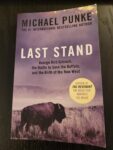
‘The Last Stand’ by Michael Punke (The Revenant) – The Battle to Save the Buffalo – The American Prairie Reserve
This is an outstanding history of the American buffalo especially when considering the current efforts to thwart the work of the American Prairie Foundation to develop what could be our next National Park for all.
Michael Punke’s The Last Stand tells the epic story of the American West through the lens of the American bison and the man who saved these icons of the Western

Bureau of Land Management revokes Montanan’s American Prairie bison leases – Governor Gianforte Praises BLM Decision
In its 2022 record of decision approving American Prairie’s Montana bison grazing plan, the BLM noted that bison grazing is permitted on leases it administers in Colorado, New Mexico, North Dakota, South Dakota and Wyoming.
Multiple Groups Working Together to Create an “Endless Buffalo Prairie” in Montana
To bring this vision into modern conservation economics, Fort Peck is partnering with other Montana groups to quantify the measurable ecological benefits of bison grazing through a biodiversity credit program.